
Description
This topic follows up a previous finished project:
https://www.vr.tuwien.ac.at/topics/qiskit-quantum-computing-programming-environment-in-unity/
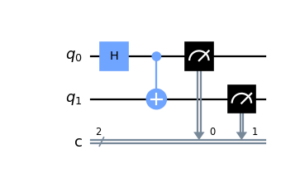
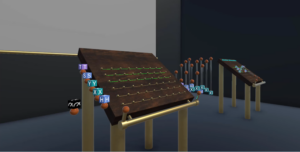
In the existing project, multiple users can collaborate on assembling quantum computing circuits in VR and executing them on a simulated quantum computer in Qiskit. The project focuses on collaborative learning of quantum computing concepts.
Goals
The goal of this topic is to expand the capabilities of the current project with features that are especially useful for learning in the context of quantum computing.
The topic can be selected as a project (PR) or a master thesis (MA). In the master thesis setting, more features need to be implemented and a comprehensive evalution of the final project conducted, with the focus on educational potential. The topic is available for up to two students working with different hardware (standalone VR glassed or LED wall).
Tasks
Features to implement (final selection will be discussed):
- Creating, saving and using “embedded circuits” – smaller QC circuits that can be abstracted into a gate and used as such
- Additional template gates and an interface for flexible gate template loading
- Algebraic description and display of the system state at specified timestampes
- Bloch sphere/ball visualizations
Hardware and Software
The project currently uses several Oculus Quest VR glasses and is implemented in Unity. This combination can be used in the further development. Alternatively, the student can choose to work in Unreal Engine, and with the LED wall in the new Mixed Reality Lab as display.
Tasks will be adjusted if the project is implemented in Unreal. Working with the LED wall requires Unreal.
Requirements
- Knowledge of Unity or Unreal, C# or C++, python
- Experience of working with VR is advantageous
- Experience of working with multi-player applications is advantageous
- Knowledge of quantum computing or Qiskit is not necessary, but interest is welcome
Contact
Iana Podkosova yana.podkosova@tuwien.ac.at