
Locomotion technique for navigating in crowded environments in Virtual Reality
16.09.2026
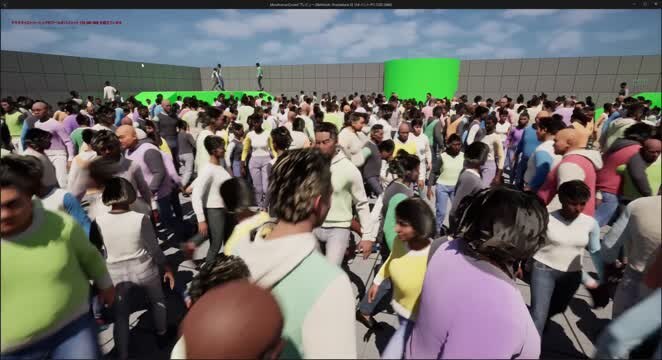
Context:
Navigating through crowded virtual environments is a common yet demanding task in VR applications, from emergency-evacuation training to urban planning and social simulations. Different locomotion techniques—such as continuous walking, teleportation, or joystick-based navigation—may substantially influence how users traverse dense crowds, how they allocate attention, and how efficiently they avoid collisions with virtual pedestrians. This topic would investigate how locomotion technique choices affect navigation performance and user experience.
Main objective:
To test how different VR locomotion techniques influence navigation performance, collision avoidance, and user comfort when moving through virtual crowd environments of varying density.
Development environment:
The project will be developed in Unreal Engine 5.8 using the metahuman crowd plugin, and will run on a Meta Quest headset.
Protocol:
- Participants navigate a virtual environment populated with computer-simulated crowds (animated virtual pedestrians with scripted movement patterns and difficulty levels).
- Navigation is performed using different locomotion techniques, each tested with and without dense crowds.
- Measures include travel time, path efficiency, number of collisions with virtual pedestrians, perceived discomfort, and relevant self-report questionnaires.
Requirements:
- Object Oriented Programming skills (C/C++/C#)
- Knowledge of Game Engines (Unity, Unreal) and Virtual Reality (VR) is advantageous
Contact
For more information please contact Hugo Brument (https://www.vr.tuwien.ac.at/people/hugo-brument/) hugo.brument@tuwien.ac.at