
[MR LAB] Locomotion techniques for navigating in CAVE systems
28.09.2026
Context:
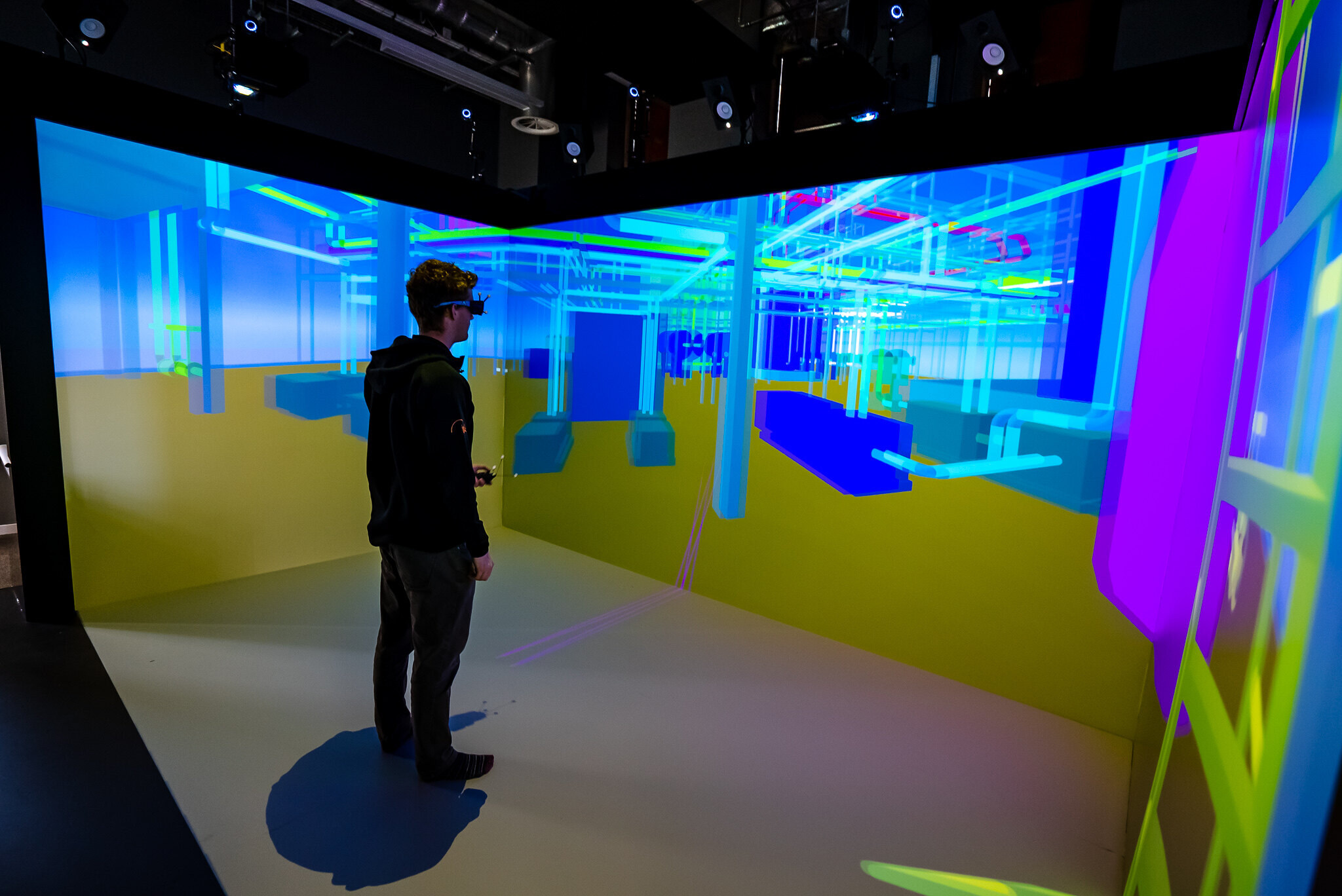
CAVEs and LED walls let users move physically, but only within a few square meters. Beyond that, navigation usually falls back on a handheld controller. Controller mappings rarely resemble human walking: speeds feel too fast or too slow, starts and stops are abrupt, and turning and sidestepping are unrealistic. Real walking is known to give the highest presence and the best spatial orientation, and walking-in-place (WIP) is a promising substitute. Both face CAVE-specific limits, though: the workspace is small, and a missing back wall forces virtual rotation. This topic would develop a hybrid technique that combines 1:1 real walking inside the CAVE with walking-in-place for longer distances, and compare it with established navigation techniques.
Main objective:
To design, implement and evaluate hybrid control laws and/or real-walking/walking-in-place technique for a CAVE. The study tests how it compares with controller-based and leaning-based navigation in navigation performance, spatial orientation, similarity to real walking, and user comfort.
Development environment:
The project will be developed in Unreal Engine for our CAVE. It will use optical tracking system with markers on the head, hips and feet or shins.
Protocol:
- A step-detection method is implemented that distinguishes real steps from in-place steps using tracked head, hip and foot data. Step frequency is mapped to virtual speed, and walking direction is taken from the hips.
- Boundary handling near the walls is added, such as switching to rate control at the edge of the workspace, or subtle rotations that turn users back toward the front walls (redirected walking in place).
- Real walking in the tracking volume is recorded to obtain reference speed and turning profiles, and to calibrate a virtual speed that feels natural.
- In a within-subjects study, participants navigate a large virtual environment using the hybrid technique, controller navigation and leaning-based navigation.
- Measures include travel time, path efficiency, start/stop latency, spatial orientation (pointing task), similarity of trajectories to real walking, simulator sickness (SSQ), presence (IPQ), workload (NASA-TLX) and technique preference.
Requirements:
- Object Oriented Programming skills (C/C++/C#)
- Knowledge of Game Engines (Unity, Unreal) and Virtual Reality (VR) is advantageous
- Experience with motion tracking systems, or an interest in signal processing, is a plus
Contact
For more information please contact Hugo Brument (hugo.brument@tuwien.ac.at) and Hannes Kaufmann (hannes.kaufmann@tuwien.ac.at).
As written, this fits a Master’s thesis. For a smaller project (BA/PR) we will not expect every steps to be developped.